

On paper, it sounds like the dullest hobby imaginable: sitting in front of a grid of tiny icons, deciding where to put a limited number of points, and then arguing about it with strangers on the internet. And yet millions of World of Warcraft players have spent entire evenings doing exactly that, often before they have even logged in.
The Burning Crusade, the 2007 expansion that took players to Outland, is a perfect case study. Its talent trees are a masterclass in how a simple system, a handful of points and a few choices, can turn into a surprisingly deep form of entertainment.
First, what is a talent tree?
For non-players, here is the short version. Every class in the game has three branches of abilities, called talent trees. As your character levels up, you earn points to spend in those trees, unlocking bonuses and new moves. By the time you reach level 70 in The Burning Crusade, you have 61 points to spend, and there are far more tempting options than points to buy them.
That mismatch is the whole point. Every talent you take is a talent you did not take.
Constraint is what makes it interesting
Game designers have long known that unlimited options are dull and limited options are exciting. A talent tree works because it forces trade-offs. Do you take the talent that makes you tougher or the one that makes you hit harder? Do you commit deeply to one branch for a powerful ability at the bottom, or spread across two for flexibility?
Changing your mind costs gold, so the stakes feel real without being catastrophic. It is exactly the right amount of pressure to make a decision feel meaningful.
The ritual: build it before you play it
Before spending a single point, most players open a wow tbc talent calculator and start experimenting. It is a tool where you pick a class, click through the trees and watch your points disappear. The one on wow tbc talent calculator lets you import an existing build, copy your talent string, grab a shareable link or reset everything with a click, which turns planning into something close to a puzzle game.
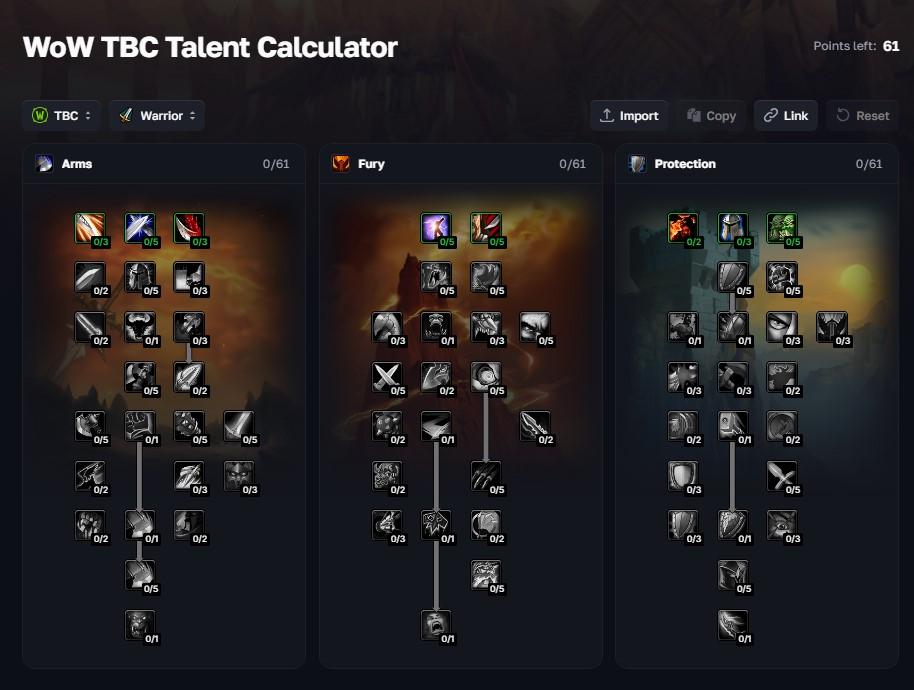
This is the secret appeal. A calculator gives you the satisfaction of designing something without any of the risk. You can try a reckless build, laugh at it, delete it and start again, all in a few minutes.
Why it is so satisfying
Planning a build taps into a few very human instincts:
- Ownership. A build you designed feels like yours, even if thousands of others have something similar.
- Identity. Your talents say something about how you want to play: cautious, aggressive, clever, stubborn.
- Problem solving. Fitting the best set of talents into a limited budget is a satisfying puzzle.
- Anticipation. Planning is a way of enjoying the game before you are actually in it, much like researching a holiday.
Three kinds of planners
Almost every player falls into one of three camps:
The min-maxer wants the most efficient build possible and will happily spend hours comparing small bonuses. For them, a Warrior’s signature talents are targets: Mortal Strike for Arms, Bloodthirst for Fury and Shield Slam for Protection, with every point on the way judged by how fast it gets there.
The roleplayer picks talents that fit a story. A tough, stubborn defender might lean on talents such as Toughness or Last Stand, regardless of what a spreadsheet says.
The hybrid takes a strong main branch and sprinkles in a few fun extras from another, accepting a small penalty in exchange for personality.
None of them is wrong. The system is flexible enough for all three, which is part of why it has lasted.
The social side
Talent builds are also a conversation starter. Guilds argue about them. Friends swap links and challenge each other’s choices. A single build link can spark twenty minutes of friendly disagreement about whether a particular point is worth it. For a game that is supposed to be about fighting dragons, a surprising amount of the fun is in the debate.
How to start if you have never done it
- Pick a class that appeals to you, not the one you think is best.
- Decide what you want to do: tank, heal, deal damage or just explore.
- Choose one tree to invest in and look for its standout talent.
- Test a second version with a different emphasis and compare them.
- Share it with a friend and listen to their objections.
Mistakes worth avoiding
Copying the first build you see. Even a popular build is more fun when you understand why each point is there.
Overthinking. A build does not have to be perfect to be enjoyable.
Forgetting the journey. A build that looks great at level 70 might feel awkward at level 30, so plan for the whole trip.
It is easy to dismiss talent planning as homework. But look closer, and it is a tiny design game: limited resources, interesting choices and a bit of personal expression. That is why a spreadsheet of icons has kept players hooked for years, and why some of the best moments in the game happen before the adventure even begins.