

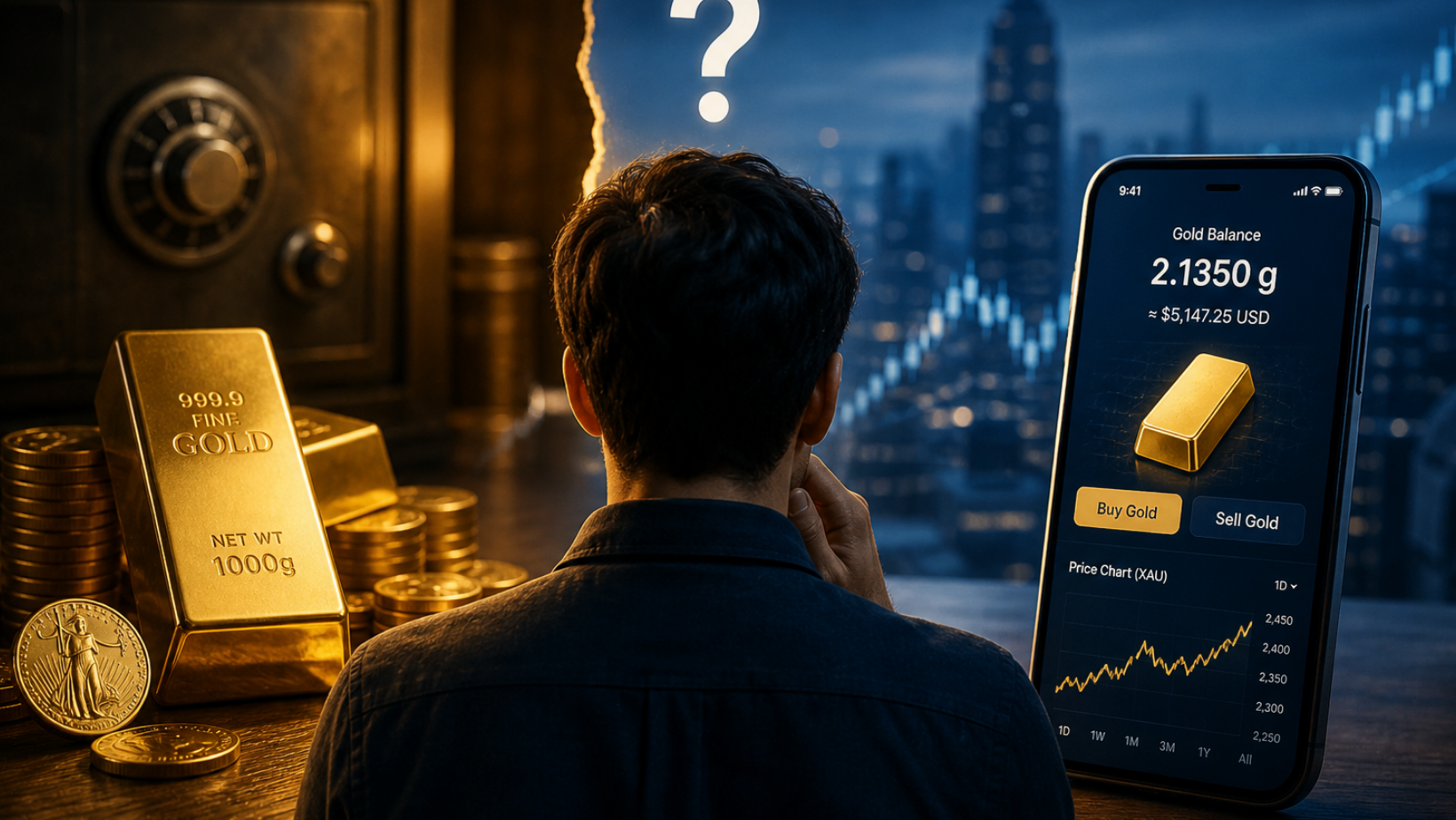
What would you trust more: a number on your phone… or a coin sitting quietly in your palm?
Gold demand hit 4,899 tonnes in 2023, the highest ever recorded by the World Gold Council. That surge didn’t come from hype—it came from unease. Inflation, currency swings, geopolitical noise… people reacted the way they always have. They reached for gold.
But the way we access gold has changed. You can still buy coins, sure—but you can also buy fractions of gold through a screen, tap twice, and call it a day.
So here we are in 2026, stuck between something ancient and something engineered. And if you’re weighing the two, you’re not alone. Let’s walk through it slowly.
The Quiet Confidence of Holding the Real Thing
You don’t really understand physical gold until you’ve held it.
It’s dense. Heavier than it should be. Almost stubborn.
Why It Still Pulls People In
Gold has a way of outlasting everything around it—currencies, markets, even entire financial systems. Here are some stats to back it up.
- During the 2008 financial crisis, gold prices climbed roughly 25%, while equities dropped sharply
- Central banks bought over 1,000 tonnes of gold in both 2022 and 2023 (World Gold Council)
That’s not just performance. That’s behavior under stress.
And the process of buying it? Still surprisingly grounded.
The Pimbex bullion catalog, for instance, presents things in a way that feels almost grounded—coins with history behind them, bars stamped and sealed, weights that make sense in your hand. You’re not guessing what you’re buying. You’re looking straight at it.
That clarity matters more than people admit.
Still, there’s friction. Storage decisions creep in—safe at home or a vault somewhere quieter. You start thinking about access, security, and responsibility.
The Rise of Tokenized Gold (and Why It Feels So Easy)
Then there’s the other path.
You open an app, tap a few buttons, and suddenly you “own” gold. No delivery trucks. No vault keys. Just a balance.
Why People Are Leaning Into It
Tokenized gold fits neatly into how we already live—fast, digital, always within reach.
- You can buy fractional amounts, even a few dollars’ worth
- Transactions settle quickly, often within minutes
- No personal storage required
ADDX and Boston Consulting Group projected that tokenized assets could reach $16 trillion by 2030. That includes gold-backed tokens, quietly gaining traction.
But something about it feels… thinner. Not wrong. Just less grounded.
You’re trusting that somewhere, in a vault you’ll never visit, the gold backing your token is sitting untouched. Audited. Accounted for. Waiting.
And maybe it is. Still, you don’t feel it.
The Trust Question No One Loves Talking About
This is where things get uncomfortable.
Physical gold asks you to trust yourself—your storage, your security choices. Tokenized gold asks you to trust systems, custodians, and code.
And systems fail. Not always dramatically, but enough.
Custody Vs. Code
A token is only as reliable as:
- The custodian holding the physical gold
- The platform issuing the token
- The audits verifying reserves
There have already been cases in broader crypto markets where “backed assets” weren’t fully backed. That shadow hasn’t completely disappeared.
Meanwhile, physical gold doesn’t rely on audits to exist. It just… does.
Here’s a side-by-side comparison.
|
Feature |
Physical Gold |
Tokenized Gold |
|
Ownership |
Direct, tangible |
Indirect, digital claim |
|
Liquidity |
Slower (selling takes time) |
Fast, often instant |
|
Storage |
Requires secure storage |
Custodian-managed |
|
Accessibility |
Higher upfront cost |
Fractional, lower entry |
|
Counterparty Risk |
Minimal |
Present (platform + custodian) |
|
Transparency |
Visible, physically verifiable |
Depends on audits and trust |
No clear winner. Just trade-offs.
So… Which One Actually Works in 2026?
Here’s the uncomfortable answer: both do. Just not in the same way.
Tokenized gold works for speed, flexibility, and integration with modern finance. It fits the rhythm of 2026—fast, connected, digital.
Physical gold works for certainty. For that strange, grounding feeling that something you own doesn’t depend on a network staying online.
And maybe the real move isn’t choosing.
It’s understanding what each one can’t do… and deciding which gap you’re willing to live with.