

A Journey Through Japan’s Central Corridor
Japan’s main island, Honshu, contains a remarkable concentration of cities, historic sites and cultural traditions. The corridor linking Tokyo, Kyoto and Osaka has long been one of the country’s most important routes, connecting political power, commerce, education and artistic life.
Today, the journey can be completed with remarkable ease, but the importance of the route is nothing new. Merchants once travelled between castle towns and trading centres, while pilgrims, officials and craftsmen moved between regions.
Modern railways have transformed the practical side of travelling through central Japan, yet the character of the places along the route remains remarkably varied. Tokyo’s immense scale gives way to Kyoto’s temples and gardens before the energetic streets of Osaka introduce another distinctly urban atmosphere.
Tokyo’s Layers of History
Tokyo is often associated with neon signs, crowded crossings and futuristic buildings, but the capital has a much older story.
The city began as Edo, a castle town that became the seat of the Tokugawa shogunate in the early seventeenth century. During the Edo period, it grew into a major political and commercial centre, eventually becoming the imperial capital in the nineteenth century.
Remnants of this history can still be found among modern neighbourhoods. The Imperial Palace occupies the former site of Edo Castle, while areas such as Yanaka retain a quieter atmosphere with traditional houses, temples and narrow lanes.
Tokyo’s diversity is particularly apparent when moving between districts. Marunouchi is dominated by corporate headquarters and contemporary architecture, while Asakusa retains a stronger connection with traditional festivals, temples and crafts.
The Capital’s Merchant Heritage
Commerce has always been important to Tokyo’s development. During the Edo period, merchants established businesses around the city, while markets supplied the growing population with food, textiles and household goods.
Nihonbashi became one of the city’s most important commercial districts. Its name is still associated with the historic bridge that marked the starting point of major roads connecting Edo with other parts of Japan.
Today, the neighbourhood combines established department stores and long-running businesses with modern offices and restaurants.
Tokyo’s shopping culture continues this tradition on a much larger scale. From luxury boutiques in Ginza to specialist stores in Akihabara and independent shops in Kichijoji, the city offers an extraordinary range of commercial experiences.
From Tokyo Towards Osaka
The Tokyo to Osaka train provides one of the most practical ways to cross Japan’s central corridor. The journey connects two enormous cities while passing through a landscape that includes urban districts, agricultural areas and mountain scenery.
The Shinkansen has made this route particularly straightforward. Travellers can leave central Tokyo and reach Osaka within a few hours, making it possible to experience both cities without dedicating an entire day to transportation.
For visitors, the journey also demonstrates the scale of Japan’s infrastructure. Railway stations function as major transport hubs, with restaurants, shops and connections to local networks integrated into the same spaces.
The speed is impressive, but the route’s real value lies in what it connects. Tokyo and Osaka have very different personalities, and travelling between them creates an easy opportunity to experience both.
Nagoya’s Industrial Legacy
Nagoya sits between Tokyo and Osaka and is often overlooked by international visitors. Yet the city has played an important role in Japan’s industrial and commercial development.
Its history is closely connected with manufacturing, engineering and the automotive industry. At the same time, Nagoya has a substantial historical heritage.
Nagoya Castle was constructed in the early seventeenth century for the Tokugawa family and became a symbol of the city’s political importance. The surrounding area contains museums and cultural attractions that explore the region’s past.
The city is also known for distinctive local food. Miso katsu, hitsumabushi and kishimen noodles are among the specialities associated with Nagoya, providing an alternative to the dishes more commonly encountered in Tokyo or Kyoto.
Kyoto’s Enduring Cultural Role
Kyoto served as Japan’s imperial capital for more than a thousand years. Although political authority later shifted to Tokyo, the city’s cultural importance never disappeared.
The historic centre contains temples, shrines, gardens and traditional neighbourhoods that reflect different periods of Japanese history.
Kiyomizu-dera occupies a hillside overlooking the eastern part of the city. Its wooden terrace provides an elevated view across Kyoto, while the surrounding streets contain traditional shops and tea houses.
Gion offers another perspective. The district is famous for its preserved wooden buildings and associations with geisha culture, although it is also a living neighbourhood where residents, businesses and visitors share the same narrow streets.
Kyoto’s Gardens and Seasonal Rhythms
Gardens are among the most distinctive elements of Kyoto’s cultural landscape. Their designs often encourage visitors to notice subtle changes in vegetation, water, light and weather.
Ryoan-ji is famous for its minimalist rock garden, where carefully arranged stones sit within a field of pale gravel.
The garden does not attempt to reproduce a natural landscape literally. Instead, its simplicity encourages contemplation and leaves room for individual interpretation.
Elsewhere, temple grounds can be much more elaborate, incorporating ponds, bridges, moss, trees and carefully shaped shrubs.
Seasonality is particularly important. Cherry blossoms bring crowds in spring, while autumn foliage transforms temple gardens into vivid displays of colour. Winter can be quieter, with snow occasionally giving familiar landscapes an entirely different appearance.
The Kyoto to Tokyo Connection
The Kyoto to Tokyo train provides the reverse link across the same central corridor, making it equally useful for travellers beginning their journey in the former imperial capital.
Leaving Kyoto by rail creates a noticeable change in atmosphere. The historic streets and low-rise neighbourhoods gradually give way to larger urban areas before the enormous scale of Tokyo becomes apparent.
The journey can also be part of a broader itinerary rather than simply a transfer. Stops in places such as Nagoya offer opportunities to explore Japan’s industrial heritage, local cuisine and regional traditions.
This flexibility has changed the way visitors can approach the country. Instead of choosing between major destinations, it is possible to combine several very different cities within one trip.
Osaka’s Commercial Character
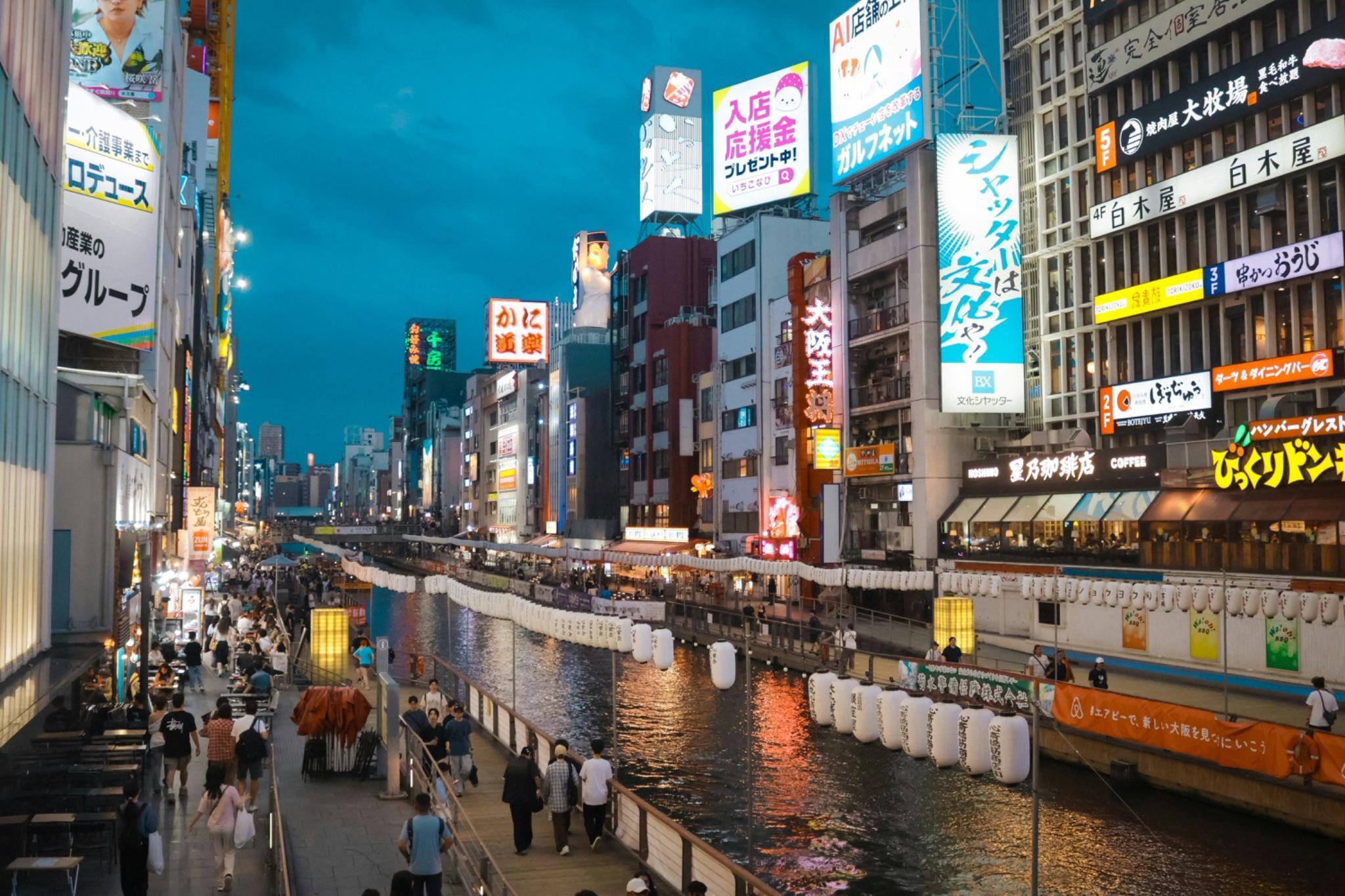
Osaka has long been associated with trade and business. Its location near the coast and its connections to waterways helped establish it as one of Japan’s major commercial centres.
The city developed a reputation as the nation’s kitchen, reflecting the importance of food distribution and merchants during earlier periods.
That reputation remains visible today. Dotonbori is packed with restaurants, food stalls and illuminated signs, while Kuromon Market offers fresh seafood, produce and local specialities.
Osaka’s food culture is famously informal. Takoyaki, okonomiyaki and kushikatsu are among the dishes most closely associated with the city.
Eating here can feel quite different from dining in Kyoto, where traditional presentation and refined seasonal ingredients are often given greater emphasis.
Osaka Castle and the City’s Past
Osaka’s modern commercial energy sits alongside a substantial historical legacy.
Osaka Castle is the city’s most recognisable historic landmark. Originally associated with Toyotomi Hideyoshi, the castle played an important role in the political conflicts that shaped Japan during the late sixteenth and early seventeenth centuries.
The present structure has been reconstructed, but the surrounding park provides a sense of the scale of the original fortress complex.
The castle’s museum explores the life of Hideyoshi and the history of Osaka, connecting the modern city with a period when control of the region was central to the struggle for national power.
Traditional Crafts Along the Route
The central corridor also connects areas with strong craft traditions.
Kyoto is renowned for textiles, ceramics, lacquerware and tea-related craftsmanship. Many techniques have been passed down through generations, with artisans continuing to work in highly specialised fields.
Osaka developed a different reputation, with commercial manufacturing and practical crafts playing a major role in its economy.
Tokyo brings yet another perspective. Traditional crafts survive alongside cutting-edge design, with workshops producing items ranging from handmade stationery to ceramics and textiles.
For visitors, these traditions provide an opportunity to take home something connected to a specific region rather than a generic souvenir.
Japan’s Tea Culture
Tea offers another connection between the cities while revealing regional differences.
Kyoto remains closely associated with the formal traditions of matcha and the Japanese tea ceremony. The ritual places emphasis on preparation, utensils, seasonal decoration and the atmosphere of the setting.
Tea houses throughout the city offer opportunities to experience aspects of this tradition, although the ceremony itself is much more structured than simply ordering a cup of tea.
Tokyo has embraced tea in more contemporary ways, with specialist cafés combining traditional varieties with modern interiors and techniques.
The contrast illustrates a wider pattern across Japan, where established customs can coexist with new interpretations.
Architecture from Different Eras
Moving along the Tokyo-Kyoto-Osaka corridor reveals a broad architectural spectrum.
Tokyo contains historic wooden buildings, Meiji-era structures, post-war developments and futuristic towers. Kyoto retains a greater concentration of traditional architecture, although modern buildings occupy much of the city as well.
Osaka’s skyline is strongly shaped by commercial development, with high-rise offices and shopping complexes spread across the metropolitan area.
Religious architecture provides a recurring counterpoint. Shrines and temples can appear unexpectedly among busy urban districts, creating pockets of quiet within densely populated cities.
Three Cities, Three Personalities
Tokyo, Kyoto and Osaka form a natural trio, but each offers a distinct experience.
Tokyo is vast, ambitious and constantly changing. Its neighbourhoods range from historic quarters to cutting-edge commercial districts, making it difficult to define through a single image.
Kyoto is more closely associated with temples, gardens, traditional architecture and the legacy of the imperial court. Its cultural institutions provide a strong connection with earlier periods of Japanese history.
Osaka is energetic, sociable and strongly connected with commerce and food. Its streets often feel more informal, with a lively atmosphere that distinguishes it from both Tokyo and Kyoto.
The Central Link
The journey between these cities is more than a convenient way of getting around Japan. It follows a corridor that has connected political centres, merchants, artisans and communities for centuries.
Modern rail travel has compressed the distances, allowing visitors to move between radically different urban environments within a single day. Yet the differences remain clear once the train doors open.
Tokyo’s immense metropolitan scale, Kyoto’s carefully preserved cultural traditions and Osaka’s commercial energy each reveal another aspect of Japan.
Taken together, they form a journey through the country’s evolving identity, where imperial history, merchant culture, craftsmanship and technological innovation continue to exist side by side. The central corridor offers an unusually concentrated glimpse of how Japan has changed while retaining many of the traditions that give its cities their distinctive character.