
How to Decide Whether an Online Magazine Article Is Trustworthy is the question readers ask when they see a dramatic headline and limited sourcing. This guide gives a compact, practical method that busy readers can use immediately. It assumes readers want fast signals, named authors, clear dates, verifiable sources, and a short checklist they can run through in under two minutes. The advice below focuses on concrete checks and quick tools so readers can identify reliable pieces, avoid misleading claims, and save time when deciding whether to act on what they read.
Key Takeaways
- Check for a named author with a linked bio and verify their expertise to ensure the online magazine article is trustworthy.
- Look for clear publication details, including editorial policies and ownership transparency, to assess the reliability of the source.
- Verify that the article cites primary sources, named experts, and includes a recent publication or update date relevant to the topic.
- Use quick tools like exact headline searches, reverse-image lookup, and domain checks to confirm claims within minutes.
- Confirm consistency of key facts across independent reputable outlets to strengthen trust in the article’s accuracy.
- Apply a concise five-point checklist—author, publication, evidence, date, and cross-source consistency—to rapidly identify reliable online magazine articles.
A One-Page Trust Checklist You Can Use Immediately
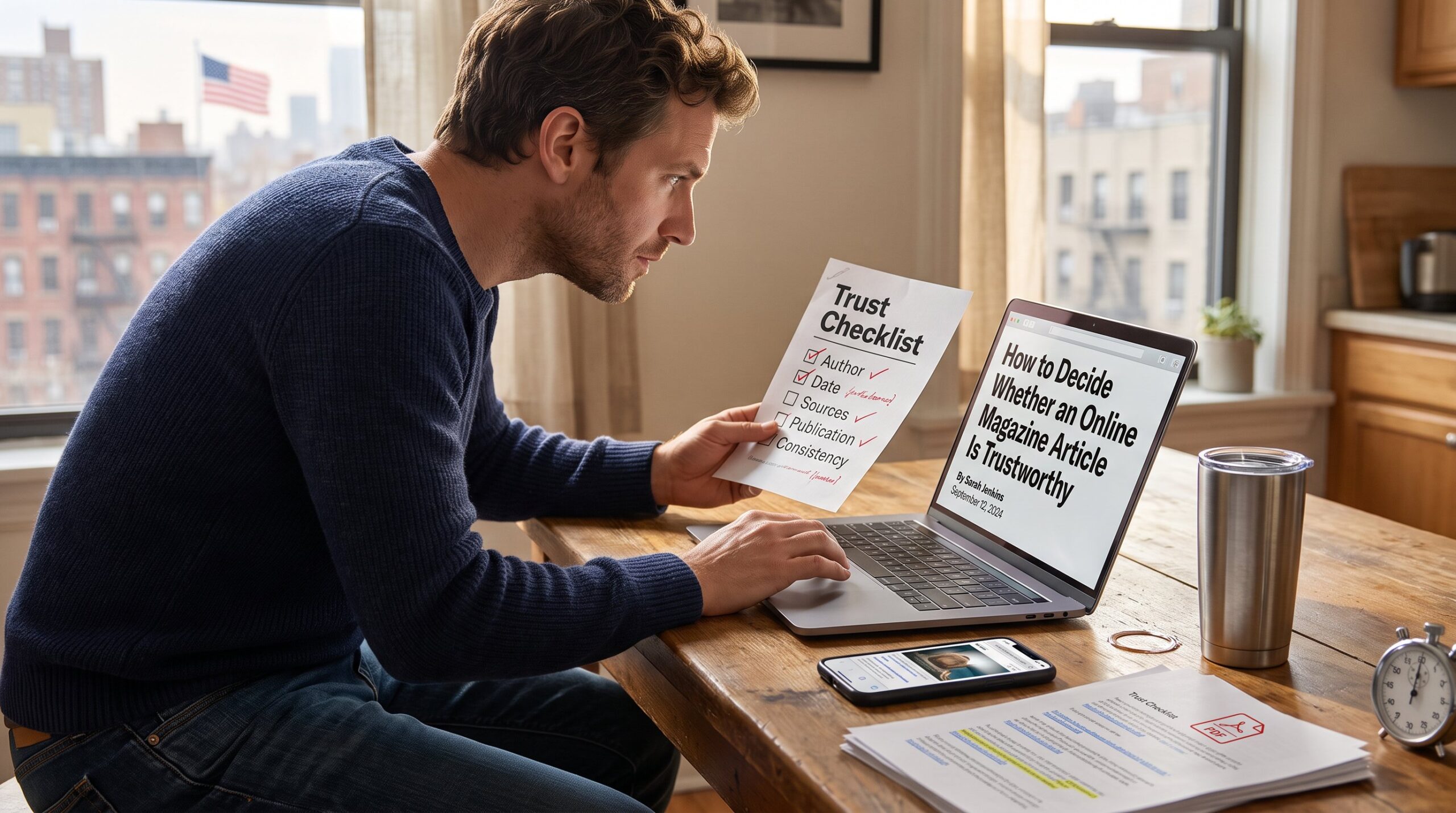
Start with this single-page answer: named author, visible date, primary sources, clear editorial standards, and consistent facts across independent outlets. Those five items catch most bad pieces within 60–120 seconds.
Author: Confirm a real byline and a linked bio. If the article lists a full name with credentials, treat it as more trustworthy than anonymous copy. Publication: Find an About or Staff page and look for contact or ownership details. Absence of this information is a red flag. Evidence: Scan for named sources, documents, or data links. If every claim traces to an identifiable source, the article is easier to check. Date: Check the publication or last-updated date: time-sensitive topics need recent dates. Consistency: Search one key claim and see if two independent outlets report the same detail.
Practical timing: a trained reader can run these five checks in about 90 seconds. This list often separates solid reporting from click-driven summaries that recycle unverified claims.
Evaluate The Author And Publication
Answer first: a credible article usually names an author with relevant expertise and appears on a site that shows editorial oversight.
Search the author’s name for prior coverage on the topic. If the author has bylines about the same subject, that signals experience: if not, treat their article as an opinion piece until sources prove otherwise. Check whether the publication publishes an editorial policy, corrections page, or staff list, those pages show accountability. A newsroom that lists editors and contact emails signals a working editorial operation.
Investigate ownership and funding. Publications funded by recognizable journalism groups tend to list sponsors and revenue models. If funding or sponsorship is hidden, readers should be cautious. Also look for conflict-of-interest disclosures, especially for articles about products, finance, or health.
Readers who want contextual help can compare the outlet’s tech coverage with the site’s broader approach in a short primer on the site’s scope, such as the magazine’s overview of technology and biographies in 2026, which explains editorial focus and resources used in reporting: magazine overview.
Verify Evidence, Sources And Date Relevance
Fact up front: claims that cite primary sources or named experts are far easier to verify and hence more trustworthy.
First, trace claims to originals. Good articles link to studies, government reports, or interview transcripts. If a claim traces only to another article, ask whether that source itself cites primary material. Prefer documents and data files over anonymous summaries. Second, check source quality: university research, official records, and recognized organizations rank higher than promotional material or single social posts.
Date matters. For fast-moving fields like tech, finance, or medical news, a two-year-old article can be outdated. For profiles or historical pieces, older dates may still be valid. Look for a visible publication date and a last-updated stamp. If either is missing, treat accuracy as questionable.
Example: an article reporting a new app’s privacy policy should link to the policy page and the company’s changelog. If those links are absent, the reader must verify the claim themselves or deprioritize the article.
Quick Tools And Practical Steps To Confirm Claims
Clear answer up front: use a handful of quick tools, reverse-image search, headline exact-match searches, domain checks, and cross-source comparison, to confirm or debunk claims in about five minutes.
Step 1: Search the exact headline plus the author’s name. If multiple reputable outlets independently report the same facts, the claim gains credibility. Step 2: Run a reverse-image search for any photos to see where the image first appeared and whether it’s been reused out of context. Step 3: Check the domain’s WHOIS or About page for ownership and contact info when sponsorship or bias is suspected. Step 4: Compare the article with primary documents cited: open cited PDFs or datasets and verify that numbers match.
Tools readers can use quickly: Google News exact-match search, TinEye or Google Images for photos, and simple domain inspection via the site’s About page. For celebrity or net-worth coverage, a targeted source-check can be guided by the site’s resource about vetting celebrity sources: source checking guide.
Practical warning: fast checks aren’t perfect. A plausible-looking document can be manipulated, and reputable outlets can make mistakes. If a claim matters for money, health, or legal decisions, seek the original document or an expert confirmation before acting.
Conclusion
Readers who apply the five quick checks, author, publication, evidence, date, and cross-source consistency, will filter most unreliable articles without much time. The approach rewards healthy skepticism and fact-first verification rather than instant belief. For ongoing practice, readers can bookmark a short list of trusted outlets and the magazine’s technology guide to spot consistent standards over time: technology section guide.