

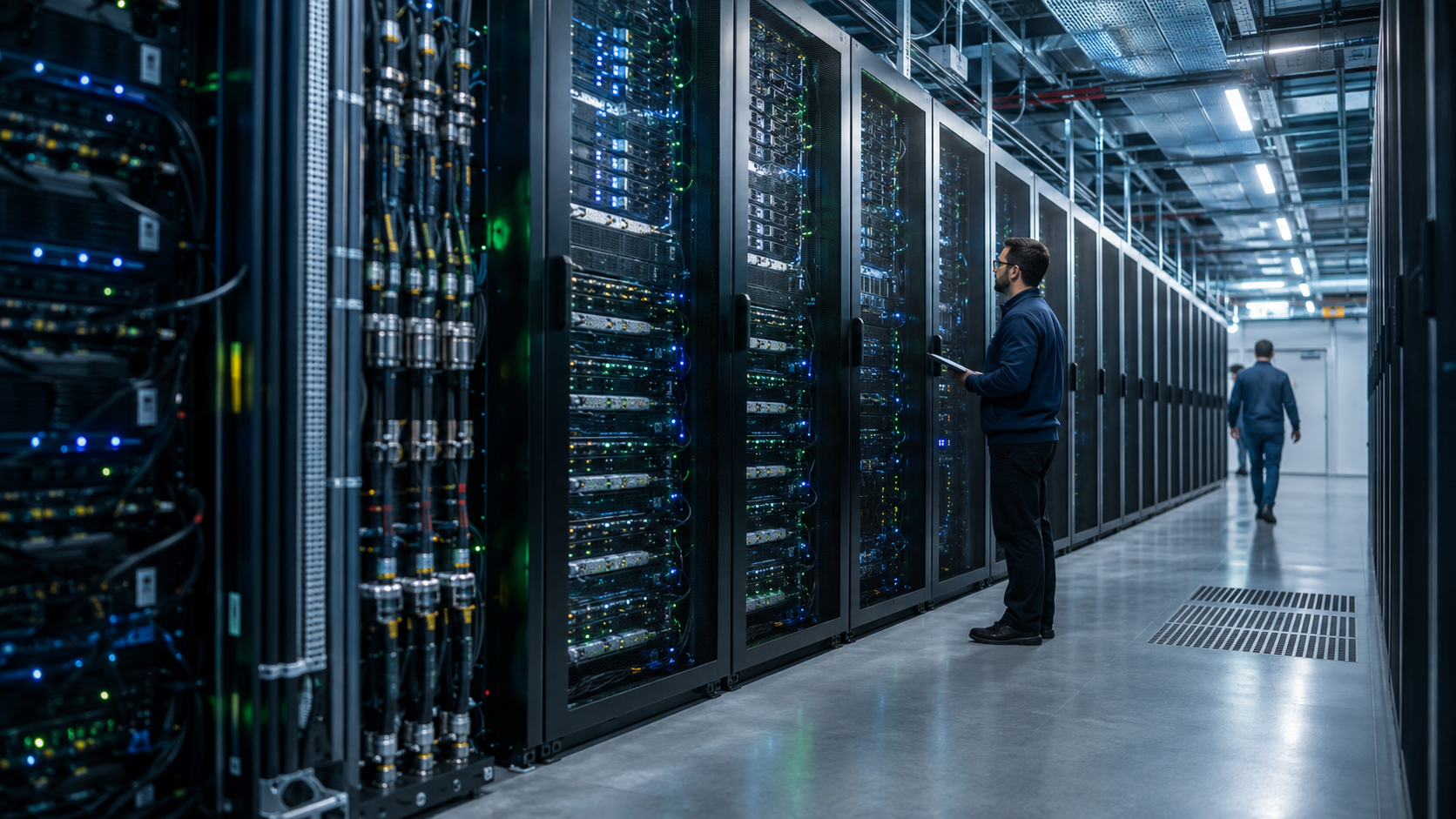
Artificial intelligence often feels weightless. Type a question into a box and an answer appears. Ask for an image and one arrives within seconds. The whole process can seem like software floating somewhere in the cloud.
The reality is far less airy. Every response depends on physical machines. Those machines sit inside large buildings filled with GPU servers. They rely on fast networks and huge storage systems. They also need a steady supply of electricity and cooling.
As AI demand grows, these facilities are starting to look less like ordinary data centers. They work more like digital production plants. Data enters. Computing systems process it. Trained models and generated results come out.
That new model is often called an AI Factory. The name helps explain a major shift in technology. AI is moving from a software experiment into a full industrial system.
From Server Room to Production Line
Traditional data centers support many kinds of work. They host websites and databases. They run business software. They store files and process transactions.
AI infrastructure has a narrower mission. It turns data and computing power into useful model output. That output may be a trained model. It may also be an image or prediction. In many cases, it is a stream of generated tokens.
The process resembles a production line:
- Raw data enters the system
- Software prepares and organizes the data
- GPU clusters train or refine a model
- Storage systems preserve model checkpoints
- Inference servers respond to live requests
- Monitoring tools feed performance data back into operations
Each stage depends on the others. A powerful GPU cluster can still perform poorly with slow storage. A fast model may also struggle if the network creates delays. The facility must operate as one connected machine.
Buying GPUs is only the first step. Operators must connect and manage them. They must keep the hardware busy. They also need to repair failures without stopping the entire workload.
What Makes an AI Production Site Different?
From the outside, an AI facility may look like any other data center. Inside, its priorities are different.
| Area | Traditional data center | AI production environment |
| Main workload | Websites and business applications | Model training and inference |
| Processing | General-purpose CPUs | Large GPU clusters |
| Networking | Standard enterprise traffic | High-speed server connections |
| Storage | Files and databases | Massive training datasets and checkpoints |
| Power demand | Spread across mixed workloads | Dense demand from accelerator hardware |
| Main goal | Reliable application hosting | High output from expensive compute |
The biggest difference is density. AI servers can draw far more power than standard enterprise systems. They also generate more heat. Cooling becomes part of the computing strategy rather than a background service.
Networking matters just as much. Training a large model can involve hundreds or thousands of GPUs. Those processors must exchange information at high speed. A slow connection leaves costly hardware waiting.
Storage faces similar pressure. Training datasets can be enormous. Model checkpoints also need to be saved often. If storage cannot keep up, the entire cluster slows down.
Four Systems Have to Work Together
The most visible part of an AI site is the GPU rack. Yet the rack cannot do much on its own. Four major systems must work as a single unit:
- Compute. GPUs perform the mathematical work behind training and inference. CPUs handle supporting tasks.
- Networking. High-speed connections move data between servers. They help hundreds of processors act like one machine.
- Storage. Fast systems hold datasets and model files. They also preserve checkpoints during long training runs.
- Power and cooling. Electrical systems feed the hardware. Cooling equipment removes the heat created by dense GPU clusters.
Software ties these pieces together. An orchestration platform decides where workloads run. It tracks available hardware. It can also replace failed nodes or shift jobs to open capacity.
Without that control layer, operators may have a room full of impressive equipment and no efficient way to use it. The physical hardware matters. The system used to manage it matters just as much.
Training and Inference Work Different Shifts
AI infrastructure supports two main types of work. Training teaches a model. Inference uses that model to produce an answer.
Training is the heavy construction phase. It often runs across many GPUs for days or weeks. The job needs fast networking and steady access to data. A single failure can interrupt a costly run.
Inference is closer to a live service counter. Requests arrive from users or applications. The system must respond quickly. Demand may rise without warning.
These workloads create different operating needs. Training favors large clusters and long periods of uninterrupted work. Inference favors low latency and flexible capacity. It also needs strong traffic management.
Some facilities specialize in one job. Others support both. The mix affects hardware choices and network design. It also shapes pricing.
The Expensive Problem of Idle GPUs
GPU servers are costly assets. Their economics depend on how often they are doing useful work. A processor that sits idle still occupies space. It may still require power and support. It produces no computing output.
Utilization has therefore become one of the industry’s central challenges. Operators need enough capacity to handle busy periods. They don’t want large sections of the fleet sitting dark during quieter hours.
Several approaches can improve utilization. Training jobs can run when live demand is lower. Interruptible workloads can use spare capacity. A shared marketplace can also connect unused hardware with customers who need short-term compute.
Management software plays a major role here. It needs a live view of every server. It should know which machines are healthy. It must also understand which jobs can move or pause.
The goal is simple. Keep expensive hardware productive without weakening reliability. Achieving that balance is much harder.
Location Is Becoming a Bigger Decision
Where AI computing happens can affect performance and cost. It can also affect privacy and legal exposure.
Inference systems may need to sit close to users. Shorter distances can reduce delay. A service built for one region may work better when the supporting hardware is nearby.
Energy availability also shapes location. A dense GPU site needs reliable power. It may require new grid connections or cooling infrastructure. Regions with available energy can attract new projects.
Data rules add another concern. Governments and regulated industries may require information to stay within a particular jurisdiction. They may also want local control over the hardware and support teams.
Before choosing a location, operators should ask:
- Is enough power available for future growth?
- Can the network reach customers with low delay?
- Which laws apply to stored and processed data?
- Who can gain administrative access to the hardware?
- Can workloads move if local conditions change?
These questions show why AI infrastructure is becoming part of national planning. Compute capacity can influence research and business growth. It can also affect how much control a country has over its digital systems.
Security Starts Below the Model
AI security often focuses on harmful prompts or poisoned data. Those risks deserve attention. So does the infrastructure underneath the model.
An attacker may target management credentials. They may look for exposed storage or weak network controls. Firmware and remote access tools can create further risk.
Dedicated bare metal can reduce some exposure. It removes co-tenants from the server. It can also remove the hypervisor layer. That does not solve every security problem.
Operators still need strong identity controls. They need encryption and network segmentation. Logs should cover both the workload and the management platform. Patching must include drivers and firmware.
Physical control also matters. Teams should know where the servers are located. They should understand who can enter the facility. Support access should be limited and recorded.
This wider view turns AI security into an infrastructure discipline. Protecting the model begins with protecting the machines that run it.
The Next Industrial Technology Story
The rise of AI is often told through chatbots and software features. The quieter story is happening inside data centers. New GPU clusters are being installed. Power systems are being redesigned. Networks are being pushed to new speeds.
This buildout will shape which companies can develop advanced models. It will also affect where new digital services are created. Regions with access to reliable compute may gain a lasting advantage.
The idea of a digital production plant makes the change easier to see. AI output is not produced by software alone. It comes from a coordinated system of hardware and energy. Skilled operators keep that system running.
The next time an AI answer appears in seconds, it is worth remembering what sits behind it. Somewhere, a physical production line has already gone to work.